Lula
Lula is a tall, bullet-headed woman with strange almond-shaped eyes, a straight nose, and an Indian-bow mouth, who appears only once in the narrative but leaves a sharp, lasting impression. She confronts Calpurnia at the entrance of First Purchase African M.E. Church, challenging her for bringing white children—Scout and Jem Finch—into the black congregation. Her challenge is not merely a personal objection but a public assertion of racial boundaries, and it exposes the complex internal politics of the black community in Maycomb as it navigates the pressures of a segregated society.
Confrontation at the Church Door
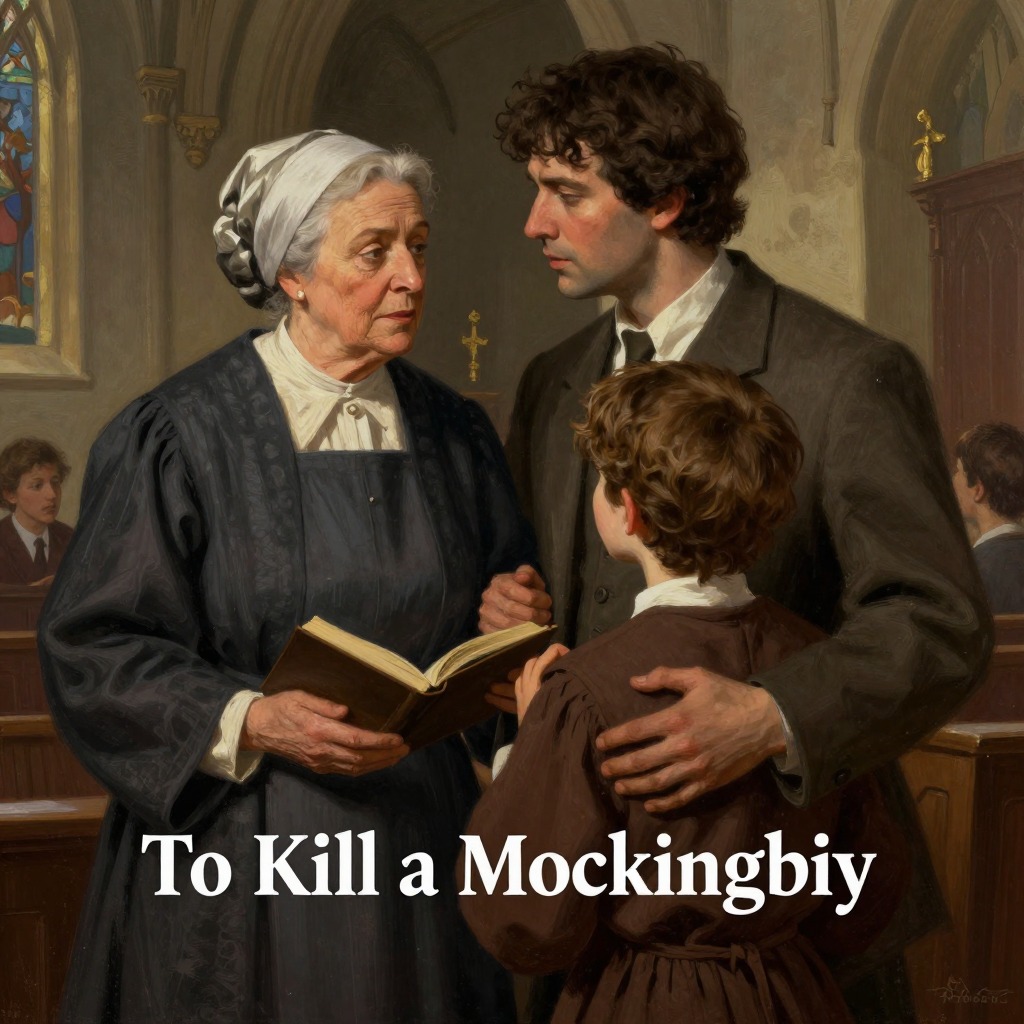
When Calpurnia leads Jem and Scout through the churchyard, the men step back and remove their hats, and the women cross their arms at their waists in respectful attention. Lula breaks this decorum. She stands in the path behind them, resting her weight on one leg, her left elbow in the curve of her hip, pointing at the children with an upturned palm. She seems seven feet high. Her first words are a direct challenge: "I wants to know why you bringin' white chillun to nigger church." Calpurnia responds in a tone Scout has never heard her use—quiet, contemptuous—and says, "They's my comp'ny." Lula presses her point, accusing Calpurnia of being "comp'ny at the Finch house durin' the week" and asserting that the white children have their own church. A murmur runs through the crowd. When Lula advances up the pathway, Calpurnia stops her with a sharp command: "Stop right there, nigger." Lula halts but insists, "You ain't got no business bringin' white chillun here—they got their church, we got our'n. It is our church, ain't it, Miss Cal?" Calpurnia answers with a theological counter: "It's the same God, ain't it?"
The Community's Response and Lula's Isolation
Lula's challenge does not carry the crowd. Zeebo, the garbage collector and Calpurnia's eldest son, steps forward to welcome Jem and Scout, dismissing Lula as "contentious because Reverend Sykes threatened to church her" and calling her "a troublemaker from way back, got fancy ideas an' haughty ways." The congregation parts, and Calpurnia leads the children to the front pew. Lula vanishes from the scene, replaced by a solid mass of colored people. Her isolation within the community is complete: her objection to the white children's presence is overruled by the church's leadership and its members, who choose to honor the Finch family's connection through Calpurnia and Atticus Finch's defense of Tom Robinson.
Thematic Significance: Racial Boundaries and Internal Division
Lula's brief appearance crystallizes a central tension in the novel: the question of who belongs where in a segregated society, and how black communities themselves negotiate the boundaries of race and solidarity. Her insistence on a separate black church reflects a defensive posture born of oppression—a desire to preserve a space free from white intrusion and control. Yet the community's rejection of her stance also reveals a more complex reality: the black church is not a monolith, and its members are willing to welcome the Finch children out of respect for Calpurnia and gratitude for Atticus's work. Lula is the voice of a separatist logic that the narrative ultimately subordinates to a vision of shared humanity and mutual obligation. Her challenge, though defeated, lingers as a reminder that the struggle for dignity and autonomy within the black community is not always aligned with the goals of white allies, however well-intentioned.